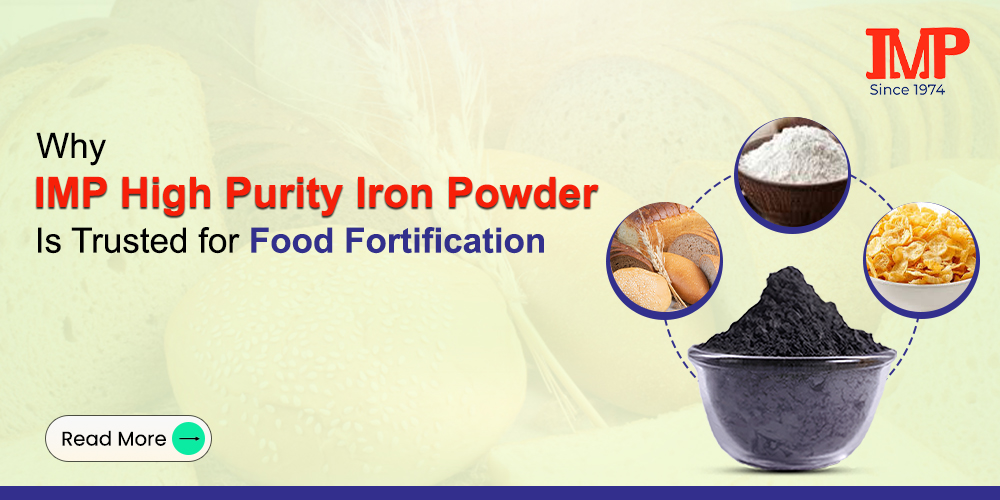
During food fortification, iron is not merely an agent. Millions of people add it to their daily diet, which helps them to stay healthy without being observed or tasting. It is the reason why food manufacturers reach beyond availability and price they are also seeking purity, control and evidence for which they choose Iron powder for food fortification.
About IMP: A Name Built on Precision
Industrial Metal Powders (IMP) has spent decades refining iron for applications where safety is non-negotiable. With a strong manufacturing presence and global reach, IMP supplies High purity iron powder and reduced iron powders to food, pharmaceutical, and oxygen absorber industries worldwide.
1. Food-Grade Purity That Fits Seamlessly into Nutrition
Every fortification story begins with purity. IMP designs iron powders to disappear into food—doing their job without altering taste, texture, or appearance.
- Controlled chemistry
- Extremely low impurity levels
Example: Fortified wheat flour retaining original taste and color
2. FSSC 22000: The Foundation of Food Safety
Food safety systems are built, not assumed. IMP’s processes align with FSSC 22000, ensuring food-grade compliance at every step.
“Food safety is not inspected at the end—it is built into the process.”
- Risk-based food safety controls
- Full batch traceability
Example: Approved supplier status for global food brands
3. Uniform Particle Structure for Even Fortification
Inconsistent particles tell a story of uneven nutrition. IMP a known, Iron powder manufacturer ensures uniform particle size so iron disperses evenly across food products.
- Excellent compressibility
- Stable particle distribution
Example: Balanced iron levels in breakfast cereals
4. Electrolytic Iron Powder That Performs Quietly
High purity iron powder is chosen when purity matters most. IMP’s process delivers iron that behaves predictably inside food matrices.
- High purity
- Minimal reactive contaminants
Example: Used in sensitive nutritional supplements
5. Why Quality Control Is Very Important
One unnoticed deviation can affect thousands of meals. That’s why IMP treats quality control as a continuous discipline, not a checkpoint.
IMP applies 100% testing for chemistry, structure, and safety—ensuring consistency before material reaches food systems.
- Prevents contamination risks
- Ensures batch-to-batch reliability
“Quality control protects people you will never meet.”
Example: Reduced rejection rates by nearly 18–20%
Image theme: Laboratory testing and quality inspection
6. Reduced Iron for Large-Scale Nutrition Programs
Not every solution needs complexity. Reduced iron from IMP supports large-scale fortification where cost and reliability must balance.
- Reliable iron content
- Easy processing
Example: Government nutrition programs
7. Strong Manufacturing Presence and Supply Stability
Food production never pauses. IMP’s manufacturing presence ensures uninterrupted supply when consistency matters most.
- Planned production cycles
- Reliable global deliveries
Example: Long-term contracts with food processors
8. Certifications That Build Confidence Across Markets
ISO 9001 – Quality
ISO 14001 – Environmental
ISO 45001 – Safety
FSSC 22000 – Food safety
E.g. expedited export market approvals.
9. Responsible Manufacturing with Purpose
Sustainability is practiced with intent at IMP—focused on efficiency, not buzzwords.
- Controlled waste handling
- Energy-efficient processes
Example: Material loss reduced by approximately 10–12%
10. Proven Performance Beyond Food
The same purity trusted in food fortification supports pharma and oxygen absorbers.
- High purity for sensitive applications
- Reliable functional performance
Example: Oxygen absorber sachets using electrolytic iron flakes
Image theme: Cross-industry applications
Particle Morphology
The shape and structural form of the iron powder are determined by the particle morphology, including flake like, irregular structure or sponge structure. IMP engineers optimize particle morphology to keep the dispersion of flour, cereals and premixes even without segregation.
To illustrate, the reduced iron particles that resemble sponges enhance the blending uniformity in the application of fortified wheat flour.
Surface Area Control
The surface area has a direct effect on the reactivity of iron, its oxidation, and its bioavailability of the food systems. The stability and release of nutrients are stabilized by an optimum set of specific surface area ranges that avoid the unwanted changes in flavour or colour.
Oxygen Content Levels
The Oxygen content is well controlled to avoid excessive oxidation that may influence the stability of the iron and shelf life. Oxygen levels in IMP are closely kept by means of accuracy reduction and manipulation. The reduced oxygen levels also guarantee uniform behavior of the fortified foods and enhance uniformity in storage.
Flowability Metrics
Flowability measures including Hall flow rate and apparent density are measured so that processing can be made smooth in automatic production lines. Flow properties- it can be used to
- Avoid clogging
- Bridging
- Uneven dosing when food fortification is done on large scale.
An example is that the maintained flowability can be used to add iron uniformly in high-speed cereal manufacturing systems.
Compressibility Behaviour
The compressibility defines the compressibility of iron powder during pressure particularly in tablet or premix compaction. The high purity iron powder produced by IMP has a high compressibility with a structure that does not affect the dispersion.
It is especially significant in the case of nutritional supplement tablets when stable density and hardness is necessary.
Conclusion
Food fortification succeeds when safety, purity, and performance align. Through disciplined manufacturing, certified systems, and carefully engineered electrolytic and reduced iron powders, IMP a known iron powder manufacturer continues to earn trust—meal after meal.